Yolandi and Will’s mother-son relationship
All My Puny SorrowsYolandi and Will’s mother-son relationship is shaped by affection expressed through messages, practical arrangements, and the work of caring for other family members. As Will establishes a life in New York, Yolandi is drawn back to Winnipeg to support Elfrieda Von Riesen; the relationship stretches across those distances without disappearing from either person’s attention.
Responsibility and everyday contact
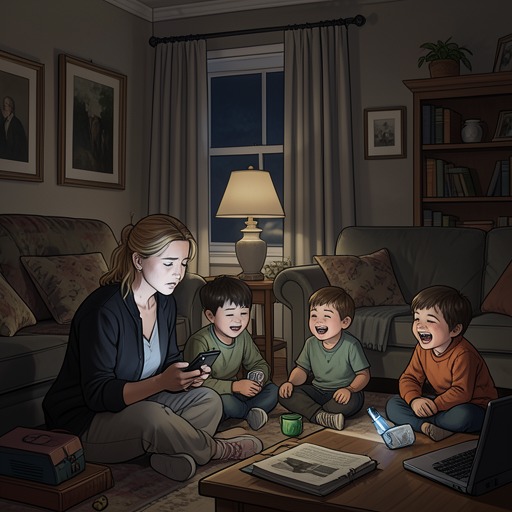
When Yolandi leaves Toronto for Winnipeg, Will is eighteen and in his first year at NYU. She has commandeered him to stay with his fourteen-year-old sister Nora for a few days, a concrete arrangement that lets Yolandi attend to Elfrieda while keeping someone she trusts at home with Nora. Their messages give this hurried delegation an affectionate, comic texture: Will reports that Nora has declared a four-in-the-morning curfew, asks Yolandi to give Elfrieda a hug, and mentions the clogged shower drain. In the same exchange, Nora reports that Will has broken the front door. The updates show family life continuing in untidy detail alongside the emergency that has taken Yolandi away.
The arrangement is not presented as effortless. Yolandi has placed Will in a position of responsibility while she is absent, and the messages reveal the ordinary problems he must manage as well as the larger family concern. His request that she pass on a hug keeps Elfrieda in the conversation, while the household complaints make clear that the family’s care is distributed through small acts and improvised help, not only through dramatic declarations.
Concern for Elfrieda
Will’s concern extends beyond his immediate household duties. While Yolandi is in Winnipeg, he asks how Elfrieda is and sends his love through his mother. Later, after returning to New York, he again asks about his aunt. Yolandi calls him while he is in a library, where he whispers that he is fine and asks how things are going; she answers in the same hushed, minimizing manner. The exchange is brief, but its mirrored whispers suggest that both are trying to make a difficult situation manageable over the phone. Neither gives the other a full account in that moment, yet the question about Elfrieda makes their shared concern plain.
Their communication also carries the strain of Yolandi’s divided responsibilities. She is trying to help Elfrieda in Winnipeg while remaining connected to Will and Nora in Toronto. When Nora does not answer her phone, Yolandi asks Finbar to check on the children at their apartment. Her anxious imagination supplies an extreme, deliberately comic explanation for Nora’s silence, but the practical request is serious: even at a distance, Yolandi remains alert to whether her children are safe. Will’s earlier stay with Nora and his later willingness to return show how this concern becomes a family task rather than something Yolandi carries alone.
New York and the limits of help
Will’s life in New York is becoming his own. He loves the city, is described as a Marxist, and is associated with both his studies and political activity; when Yolandi calls, he is often in a library or involved in Occupy Wall Street. His mother hears about this changing outlook, including his use of the title Kapital without its customary first word. Their contact therefore includes more than crisis updates: it also gives Yolandi glimpses of the ideas and commitments taking shape in his independent life.
That independence has practical limits when the family needs him. After finishing classes, Will says he is willing to return to Toronto and stay with Nora again while Yolandi remains in Winnipeg. Nora has a major school dance recital approaching, and Will asks his mother to encourage her to take better care of the apartment. He is also due to begin landscape work in Queens in a couple of weeks for someone his father knows, so he cannot remain indefinitely. The offer is generous but finite: Will can step in for his mother, yet his studies, new job, and life elsewhere continue to place claims on him.
A family network across distance
The relationship is part of a wider pattern of shared care. Yolandi’s absence depends on Will helping Nora; her conversations with him repeatedly return to how Elfrieda is doing; and Will’s messages carry affection toward his aunt as well as concern for his mother. When Yolandi considers the possibility of bringing Elfrieda to live with her in Toronto, she tells her sister that Nora is looking forward to it too. The prospect places the siblings within a family future Yolandi is trying to preserve, although Will is not named in that particular conversation.
Yolandi also turns to Will during periods when her own capacity is stretched. In one exchange, she asks Finbar to visit the Toronto apartment because she cannot reach Nora, even while she is physically in Winnipeg. The scene makes visible the distance between her roles as daughter and sister in Winnipeg and mother in Toronto. Will’s earlier and later willingness to help does not remove that tension; it gives Yolandi another person with whom the responsibilities can be shared.
Significance of the relationship
Will’s bond with Yolandi is conveyed less through extended conversations than through repeated acts of attention: staying with Nora, sending a hug to Elfrieda, asking after her, and offering to return when his mother is needed. At the same time, Yolandi follows Will’s emerging life in New York and recognizes that his availability is not unlimited. Their relationship holds both dependence and separation: a mother can rely on her adulting son for real help, but cannot make his life stop elsewhere. In the novel’s family crisis, these small exchanges show how affection persists through logistics, imperfect updates, and the negotiation of who can be present.